The Valgus Paradox: When “Bad Form” Isn’t Actually Bad

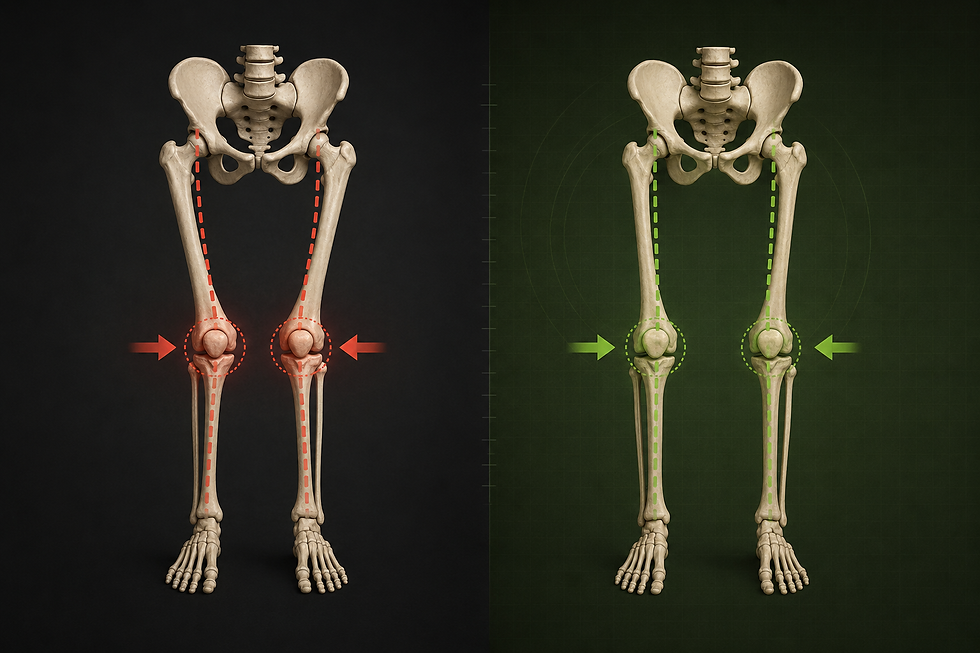
For years, lifters have been told the same thing:
“Never let your knees cave in during a squat.”
But what if that cue is oversimplified?
What many people call “knee valgus” — the inward movement of the knees during a squat — isn’t always a sign of dysfunction. In some cases, especially among experienced lifters and athletes, it can actually be part of an efficient and powerful movement strategy.
So What’s Actually Happening?
During a heavy squat, your body recruits every available muscle to finish the lift. One of the ways it creates extra force is by bringing the adductors (your inner thigh muscles) into the movement more aggressively.
That slight inward knee movement can help:
Increase force production
Assist the quads at sticking points
Improve leverage under heavy load
Help athletes finish difficult reps
In other words, your body may be adapting — not failing.
The Problem With Blanket Coaching Cues
Social media fitness advice often treats every movement deviation as something that must immediately be “fixed.”
But biomechanics are rarely that simple.
Not every squat needs to look identical.Not every athlete moves the same way.And not every valgus movement is dangerous.
Trying to force every lifter into perfectly vertical knees and textbook mechanics can sometimes:
Reduce strength output
Make movement feel less natural
Create unnecessary tension
Even contribute to discomfort over time
When Should You Actually Be Concerned?
Knee valgus becomes more important to address when:
The knees collapse uncontrollably
There’s pain involved
The feet lose stability
The movement becomes inconsistent under lighter loads
The athlete lacks control entirely
Context matters.
A slight, controlled inward movement under maximal effort is very different from unstable collapsing during basic movement patterns.
Trust Adaptation, Not Fear
The body is incredibly smart.
High-level movement often doesn’t look “perfect” by textbook standards — it looks efficient for the individual performing it.
Instead of obsessing over rigid form rules, the better question is:
Is the movement controlled, pain-free, and effective for the goal?
Because sometimes what looks wrong… is actually high performance in disguise.


Comments